Best Hot Melt Glue Production Line Equipment Manufacturer
Tel: +8618138373963 | jctmixing@outlook.com

 JCT
 2026-11-27


Most Russian hot melt adhesive producers do not fail at the mixing stage. They fail at the handover between stages.
A converter buys a 2,000 L kneader, runs it well, then adds a separate extruder, a separate pelletizer and a separate cooling unit. Each machine meets its own specification. The line still does not run: the discharge temperature of one unit is not the feed temperature of the next, the melt pump is sized for a different throughput, and nobody owns the interface.
That is the gap a hot melt adhesive production line has to close. Not by upgrading any single machine, but by treating melting, filtration, extrusion, pelletizing, dewatering and packing as one process with one set of numbers.
Demand here is concentrated in a handful of downstream sectors:
Three constraints shape equipment selection here more than catalogue specifications do.
Voltage. Russian industrial supply is 380 V / 50 Hz, three-phase. A line configured for 415 V / 50 Hz or 440 V / 60 Hz will not start on arrival. It is the most common cause of a commissioning delay on imported equipment, and it is avoidable — if the electrical specification is fixed before the purchase order.
Material contact parts. Adhesive residue is hard to clean, and hot melt oxidises against bare carbon steel at elevated temperature. SS304 on the cylinder body, head, paddles, filters, piping, cutting chamber and cooling channel is the practical default.
Climate and logistics. Winter ambient temperatures extend the cooling duty of the pelletizing stage. Import clearance and inland transport add real time to the schedule.
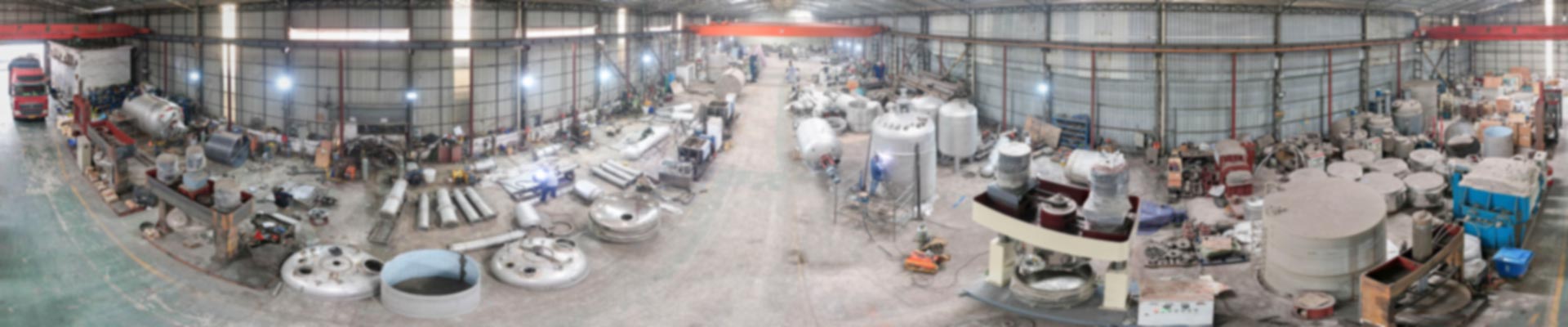
We are a source factory for high-viscosity mixing equipment and a turnkey line integrator — we don't just sell machines, we make your production line run.
Equipment. The core unit is a vertical or sigma-blade kneader/reactor sized to the batch, from a 5 L laboratory machine to units above 10,000 L, with models from NHZ-5L to NHZ-3000L.
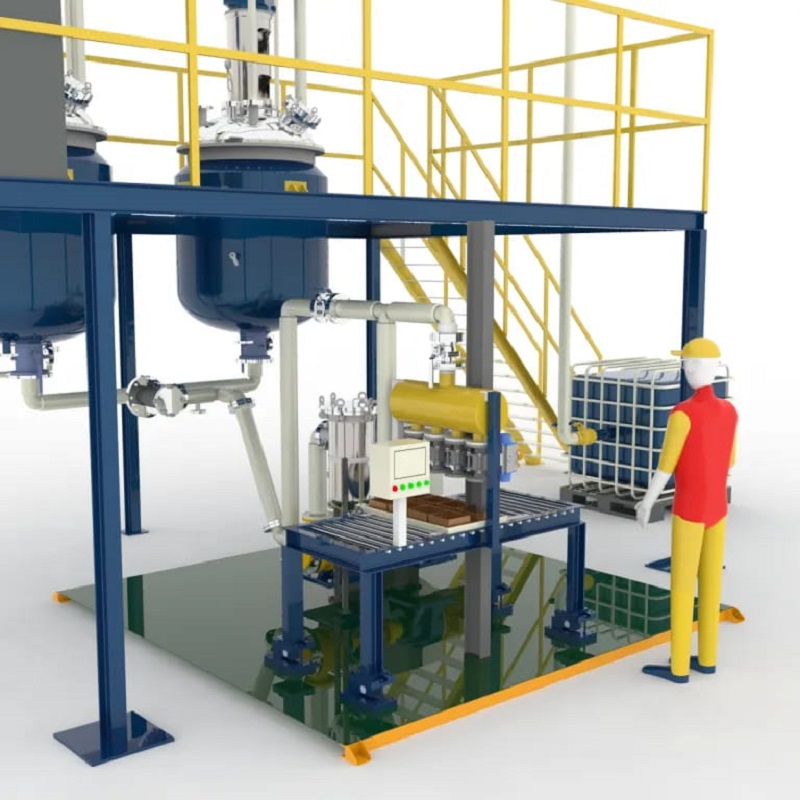
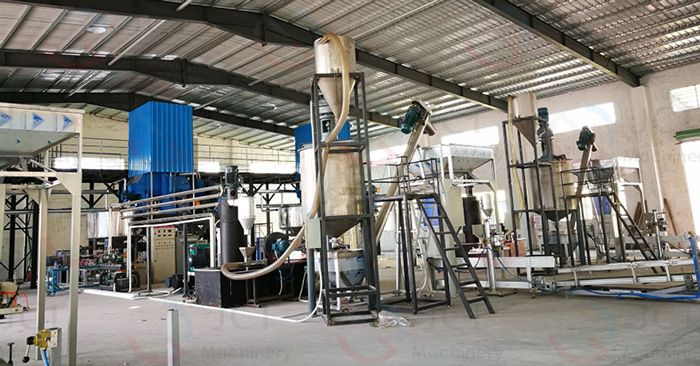
Line. We integrate feeding, melting and reaction, vacuum de-airing, coarse and fine filtration, melt pumping or screw extrusion, forming, cooling, dewatering, screening and packing. Scope follows the process flow, so the interfaces belong to us.
Repeatable capability. PLC control with recipe management and encrypted programs stores a validated recipe as parameters, not as an operator's memory.
Every line is built to a throughput and a product form. Three cover most requirements.
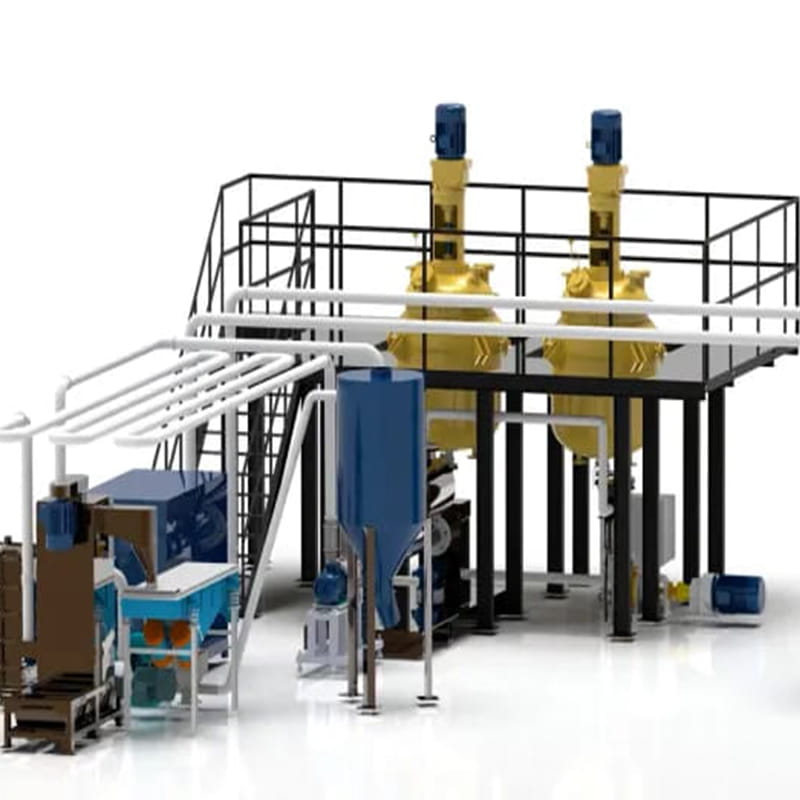
Two 1600 L reactors in parallel, each with a 30 kW motor, helical gear reducer and mechanical seal on an SS304 shaft. The reaction stage feeds an 11 kW high-temperature melt pump through a hydraulic screen changer to an underwater die head and 4 kW cutter. Cooling, separation, a 4 kW dewatering machine and a 120 kW heating furnace with 74.9 kW chiller complete the set.
The dual-reactor layout is why this suits converters running several grades. One vessel can be cleaned while the other runs.
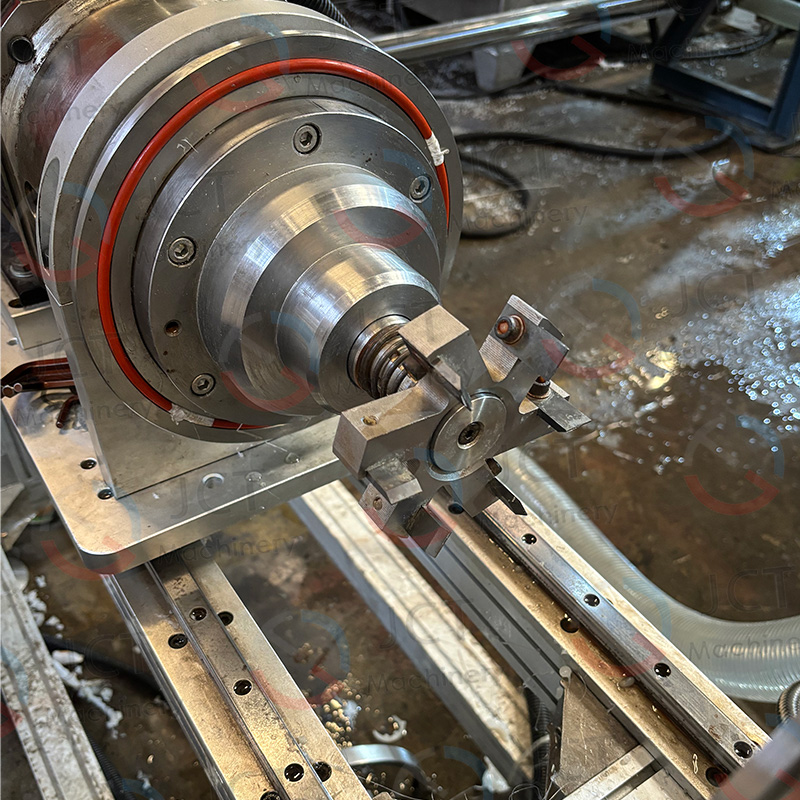
This is the configuration closest to the line we have already delivered here. An NHZ-2000L kneader with twin 55 kW motors, hardened reducers and 28 rpm SS304 paddles feeds a 22 kW discharge pump through coarse and fine filtration into a 2000 L tank. A single-screw extruder (SJ-Φ120, 22 kW) then feeds a screen changer, die, 4 kW underwater cutter, 5.5 kW dewatering machine, 500 L water tank, vibrating screen and 4 kW fan. Heating is 120 kW heat transfer oil; cooling water 37 kW.
Screw discharge is the operational point. A tilt-discharge kneader needs manual unloading and leaves the vessel open during that step. Screw discharge empties under vacuum and keeps the melt enclosed from kneader to die head, removing the manual step that caps throughput at this size.
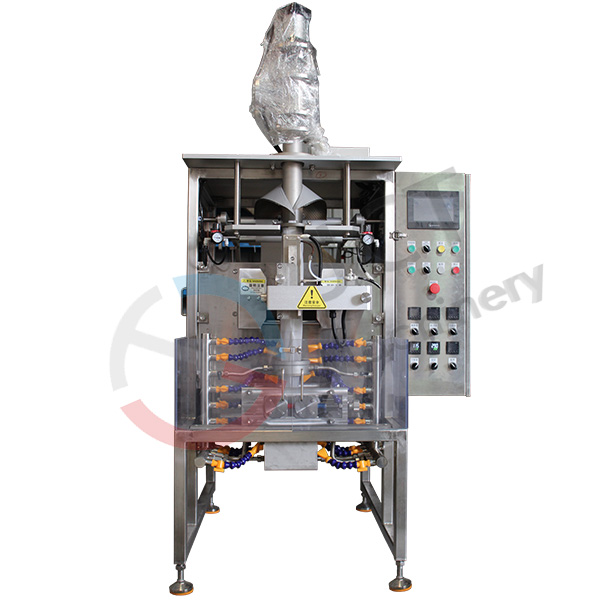
Where the product is packed as pillows, the forming stage changes completely: a 4,000 L SS304 vessel, a dedicated hot melt filling machine, an SS304 cooling channel with 37.8 kW chiller, lifting and parallel belt conveyors with blow-drying, and SS304 receiving containers. Here the constraint is fill-weight repeatability and film sealing, so we size the filling machine to the target pack weight and film width.
Beyond these three, we build block, strip, sheet and powder lines. The downstream stage differs by form; the melting, de-airing and filtration front end stays common.
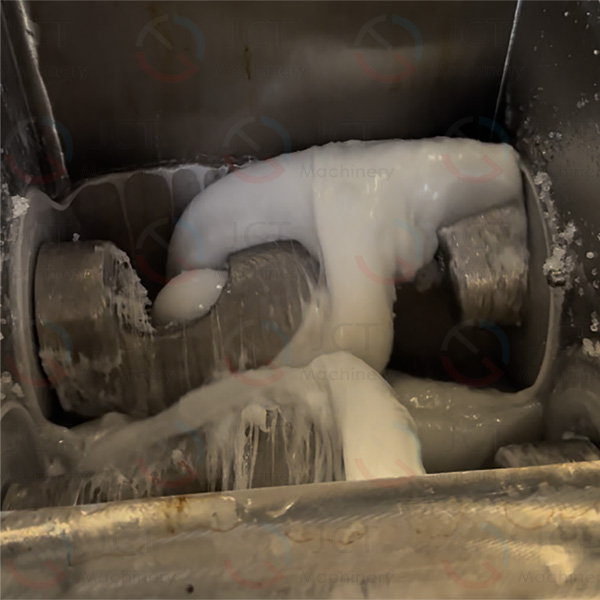
We have supplied a hot melt adhesive underwater pelletizing production line to a customer here, built around a 2,000 L screw-discharge kneader with a 2,200 L reactor. That project was our fifth order from the country.
We treat that number carefully. A first order tells you the specification matched. A fifth order tells you the line kept running after commissioning, when the customer was measuring output rather than promises. Repeat orders from the same market are a more reliable reference than any equipment list.
On compliance: our quality and environmental management systems are certified to ISO 9001 and ISO 14001, and our equipment carries CE marking. Where a project needs further documentation — material certificates, electrical schematics, customs conformity paperwork — we prepare it against the confirmed order specification.
Drawings are issued within three days of process confirmation. Standard machines ship in about 30 days; custom lines take 30–60 days, with 7–15 additional days for export packing and documentation. Every unit includes commissioning, operator training and three years of after-service support.
Progress runs in six checkpoints: drawing confirmation, material cutting, welding, assembly, trial run, packing and shipment.
Before the order we work from a 3D process demonstration, not a catalogue: send the formulation viscosity, batch size and target output, and we return a configuration plus a 3D layout of the line in your building. To see the machines under load, visit our Foshan plant — three to five days' notice lets us arrange a trial run.
If you are planning a hot melt adhesive production line in Russia, send three numbers: working viscosity in cP, batch size in litres, and target output in kg/h. Add your product form and your supply voltage.
We will come back with a line configuration, a 3D layout and a delivery schedule — not a generic catalogue.
Email: jctmixing@outlook.com
24-hour service hotline

Tel: +86 18138373963
Add: Donglian Jincheng Industrial Zone, Danzao Town, Nanhai District, Foshan City, Guangdong Province, China