


How Pillow-Form Hot Melt Adhesive Is Made: The Forming Process Explained
Pillow-form hot melt adhesive is produced through the same melt–mix–filter chain as other solid HMA forms. The difference is at the tail end: the melt is extruded through a die and set in a water cooling trough to create the pillow shape. Two pillow sizes are common on the market — 0.5 kg and 0.2 kg — and the wrapping step that follows forming is a separate downstream operation.
Why the forming stage decides whether a pillow batch sells
For a buyer of solid hot melt adhesive, the melt preparation is only half the story. A pillow that is off-weight, poorly set or uneven in shape will jam a downstream applicator, and a batch that varies from pillow to pillow will be rejected even if the chemistry is correct. That is why the forming stage — the short section from the die to the cooling trough — deserves as much attention as the reactor that came before it.
The problem buyers usually describe is consistency: getting the same pillow, at the same weight, from the same melt, shift after shift. Fixing that is a question of equipment and process control, not of changing the formula.
Where pillow-form HMA sits in the product range
Hot melt adhesive is a thermoplastic solid: its physical state changes with temperature while its chemistry stays the same. It is solvent-free, odourless and solid at room temperature, which is exactly why solid forms are preferred for transport, storage and automated feeding. JCT's own product material lists six physical forms — block, granule, strip, powder, pillow and sheet — and six chemical families: PE/PP, EVA, PET, PA, TPU and SBS/SIS/BR.
Pillow form is used across the same downstream industries as other solid HMAs: packaging (carton sealing, labelling, bookbinding), woodworking and furniture, footwear, textiles, electronics, automotive interiors and medical products. The choice of a pillow rather than a block or granule is usually driven by how the customer feeds the adhesive into its applicator, not by a different chemistry.
JCT's role in the forming line
JCT Machinery was established in 2006 and is a source factory for high-viscosity mixing equipment and a turnkey line integrator. Design, machining, assembly and trial running are done in-house, and around 95% of orders involve customized production lines. We don't just sell machines — we make your production line run.
For pillow-form HMA, the relevant scope is the chain that creates the pillow: melt preparation, filtration, extrusion through the die and cooling in the water trough. The wrapping that follows is a separate downstream operation. Being clear about that boundary is part of specifying a line correctly — you should know which supplier is responsible for which step before you sign.
The five-step forming process
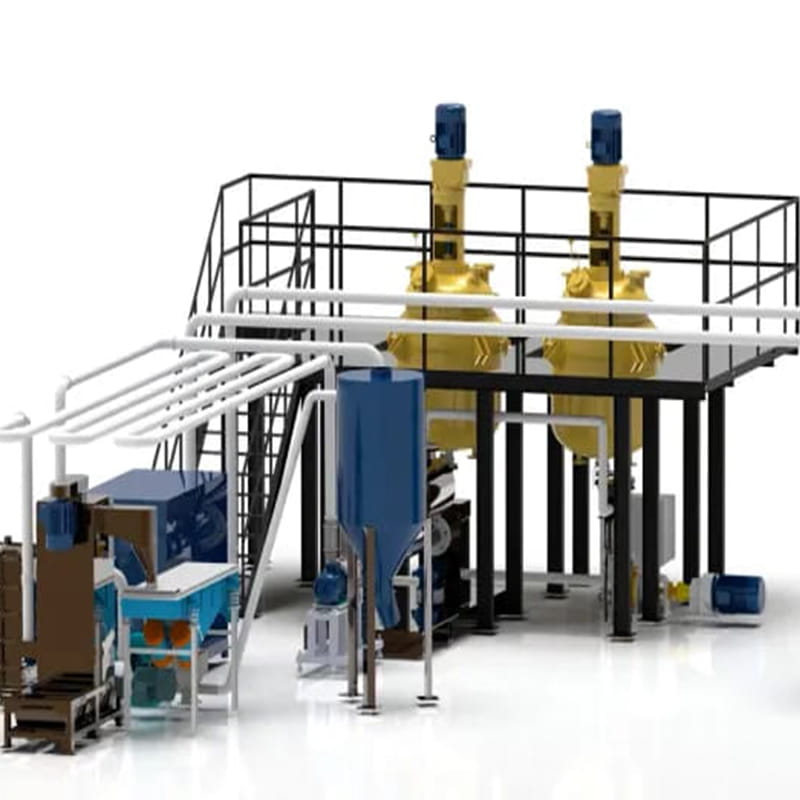
Across all solid HMA forms, the main line follows the same five steps. The forming stage is step four.
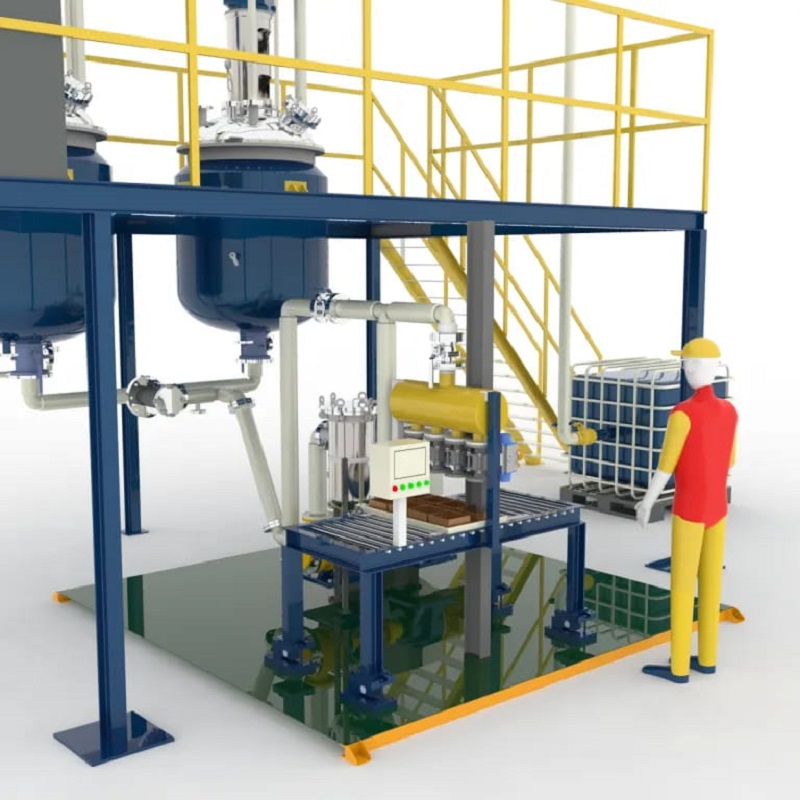
- Feeding and melting. Weighted raw material goes into the reactor or kneader, where it is heated and stirred until molten.
- Vacuum deaeration. Air is pulled out and the melt is filtered before it enters the holding vessel.
- Extrusion feed. Melt from the holding tank is metered into the extruder by a feed pump or melt pump. Extrusion speed is selected by glue type.
- Cooling and forming. For pillow form, the melt passes through a discharge die (extruder) and then into a water cooling trough, where the pillow shape sets.
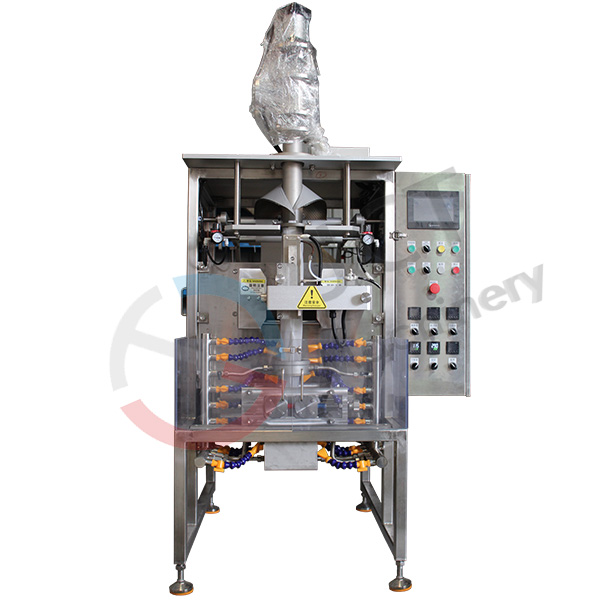
- Screening and packing. The formed product is screened and then packed.
The front end is shared with every other form: reactor or kneader → optional holding tank → coarse filter → high-viscosity pump → fine filter → heating and vacuum systems. The difference between one solid form and another lives almost entirely in step four.
What changes across forms — and what does not
The table below shows how the tail end changes while the melt chain stays the same.
| Form | Downstream forming equipment |
|---|---|
| Block | Roller conveyor, portioning die head — no extrusion or pelletising |
| Granule | Discharge die (extruder) + underwater strand pelletiser + centrifugal dewatering + vibrating screen + cyclone separator |
| Strip | Water cooling trough + haul-off + strand cutter |
| Sheet | Water cooling trough + haul-off + granulator + vibrating screen + cyclone dryer |
| Pillow | Discharge die (extruder) + water cooling trough |
Two practical notes follow from this. First, pillow form has one of the shortest downstream chains — there is no pelletising, cutting or dewatering section between the die and the finished product. Second, because the pillow sets in water, cooling control at the trough is what holds weight and shape consistent; the die determines the section, the trough determines whether it holds.
Common market sizes for pillow-form HMA are 0.5 kg and 0.2 g. These are market specifications, not a JCT-exclusive range — a line is configured around the size and output the buyer actually needs.
The engineering behind a consistent line
A forming line is only as steady as the melt feeding it. JCT builds the upstream mixing and filtration equipment with the same engineering detail used across its high-viscosity range: blade-to-wall clearance held to a narrow band, heavy-duty hardened gear reducers for stiff material, multi-stage mechanical sealing with a vacuum balance structure, and PLC control with recipe management for batch repeatability.
The company holds 17 utility-model patents and 2 software copyrights, and equipment spans 5 L lab machines to industrial units above 10,000 L. More than 3,000 customers have been served across seven export regions — North America, Europe, Africa, Southeast Asia, the Middle East, the CIS and South America. Around 95% of orders are custom lines, so blade profile, torque, vacuum and temperature control are matched to the actual material rather than taken from a catalogue.
If a project needs both the melt section and the downstream forming, JCT integrates them into one customized line — from feeding and mixing through filtering, extrusion, cooling and discharge.
Quality, delivery and support
JCT's quality and environmental management systems are certified to ISO 9001 and ISO 14001, and its equipment carries CE marking. Every project starts with a 3D process demonstration, with drawings issued within three days of process confirmation. Customers can run their own material in a trial before ordering. Standard machines ship in around 30 days; custom lines take 30–60 days, with extra time reserved for export packing. Each unit includes commissioning, operator training and three years of after-service support.
Tell us your pillow size and output
Send the adhesive type, target pillow weight, batch size and required output. We will design a custom forming line around that specification — melt chain, die and cooling section — and tell you plainly where forming ends and downstream wrapping begins.
JCT Machinery — source factory and turnkey partner for hot melt adhesive lines and complete production lines. We don't just sell machines — we make your production line run.
Contact: jctmixing@outlook.com · hotglueequipment.com